
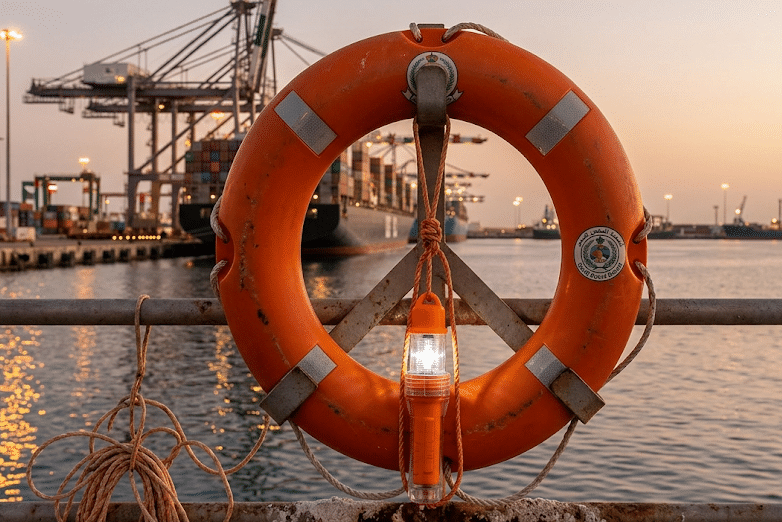
A crew member goes over the side at night, and the deck lamps reveal nothing but black water. That is why we treat a lifebuoy light in Saudi Arabia as a core part of vessel safety, not an afterthought.
In daylight, the bridge team can follow a bright orange ring across the water. After dark, that ring blends into the sea, especially with spray, swell, and a moving hull. A lamp on the buoy gives watchkeepers a focal point to keep their eyes on.
At Blue Anchor Marine, we supply marine safety equipment to operators across Saudi Arabia, and buyers often ask us how to choose the right unit. This article answers that question in plain terms, so your team can ask better questions before placing an order.
Why Does Darkness Change the Job?
Searching at night is different from searching in daylight. Color matters little, depth is hard to judge, and the sea surface never stops moving. A steady or flashing light is far easier for the eye to hold than a dark shape on dark water.
Operators in the Kingdom work in conditions where night duty is routine. Vessels call at ports on the Red Sea coast and in the Arabian Gulf, run offshore support routes, and handle cargo around the clock. Nighttime visibility is part of normal operations, not a rare case.
The lamp is a small item in a large safety set. It still has one job, and it has to do that job with no fuss.
How the Lamp and the Buoy Work Together?
The buoy provides flotation and a recognizable shape. The lamp provides a signal that remains visible in the dark. Neither replaces the other. A buoy without a working lamp is hard to see at night, and a lamp on its own has nothing to keep it afloat.
Many units are designed to turn on automatically when they contact water, so no one has to find a switch in an emergency. How a given unit behaves and what power it uses are details to confirm with the supplier and the product documents. We would not ask you to assume them.
A marine lifebuoy light is built for salt spray, vibration, heat, and rough handling, which an ordinary torch is not designed to withstand. Look for a housing and lens that suit sea conditions, and for clear manufacturer guidance on how the unit is meant to be used.
Think of man overboard lighting as a chain. The lamp marks the position, the buoy keeps the marker afloat, and the bridge team maintains visual contact. If one link is weak, the whole chain fails at the worst moment.
What Hazardous-Area Marking Means for Buyers?
Some vessels, such as tankers and offshore units, carry cargo or operate in areas where flammable gas or vapor may be present. In these settings, ordinary electrical equipment can become an ignition source. Hazardous-area marking exists for that reason.
ATEX is a European framework for equipment used in potentially explosive atmospheres. When you see an ATEX lifebuoy light listed, treat the marking as a prompt to review the paperwork, not the end of your checks. The exact zone, group, and temperature class vary by product, and we do not claim any of them here.
A mark on the housing is not a general permission. Match the marking and the certificate to the area where the lamp will be kept and used, and ask the supplier to clarify anything unclear. If your safety officer or class surveyor sets requirements for a vessel, those requirements come first.
For the product we supply, see our lifebuoy light product page, where you can read the listing and request details before you order.
Where Are These Lamps Kept on Board?
Lamps belong with the buoys, and buoys should be placed where a person can reach them in seconds. On most vessels, that means positions near the bridge wings, along open decks, and near the stern, in line with the vessel’s safety plan and applicable rules.
Keep the unit clear of clutter, standing water, and heavy gear that could crush it. Heat matters in Saudi Arabia. A lamp left in direct summer sun on an open deck endures more stress than one kept in a shaded holder, so ask the supplier about temperature limits rather than guessing.
Our team at Blue Anchor Marine recommends walking the deck with the safety officer before you order. Count the buoy positions, note which ones sit in hazardous areas, and write down what each position needs.
That habit turns man-overboard lighting into a matter of planning, not guesswork. A written list also helps when a unit needs replacing later.
How Crews Check Them?
A lamp that has sat untouched for a year may not work when it is needed. Crews should include these units in regular safety rounds, following the manufacturer’s instructions and the vessel’s routine.
A visual check covers a lot. Look for a cracked lens, loose or damaged housing, corrosion, signs of water inside, and a worn or frayed attachment to the buoy. Read any date markings or replacement notes in the product documents.
If a unit appears questionable, record it and replace it. Do not leave it in place and hope.
Testing methods vary by model. Some units have a test feature, while others do not. Follow the guidance that accompanies the unit, and do not devise a test that could damage a sealed lamp or compromise its hazardous-area marking.
Record each check in the vessel log so the next officer can see when the unit was last inspected and by whom.
Questions to Put to Your Supplier
A good supplier answers directly. Before you order, ask which documents accompany the unit and whether they cover the marking you need. Ask how the lamp turns on, what powers it, and how long the supplier recommends keeping it in service.
Ask about temperature and water-exposure limits and whether replacement units or parts are available. If an answer is vague, treat that as useful information in itself.
Delivery matters as well. When you buy a lifebuoy light in Saudi Arabia, check lead times, delivery points, and whether the supplier can handle repeat orders for a fleet. Late stock leaves vessels with gaps in their safety set.
If you are comparing an ATEX lifebuoy light with a standard unit, send us the vessel type and the areas involved. We will tell you what the product page and documents say.
We handle these conversations directly at Blue Anchor Marine, and our answers come from the product documents, not from guesswork.
Matching the Choice to Your Fleet
Fleets differ. A tanker, a tug, a supply vessel, and a passenger ferry carry different risks, so the right lifebuoy light in Saudi Arabia for one hull may not suit another. Start with where each vessel operates and what it carries.
Keep a simple record for each ship listing every buoy position, the marine life buoy light assigned to it, and the area marking that position requires. That record makes audits and reorders far easier.
Ask each vessel’s master or safety officer what has gone wrong with past units. Their answers often show which features matter most.
Standardizing on one model where it suits makes training and checks simpler because crews learn a single unit. Do not force that model into a hazardous area that calls for different marking.
Before your next order, check three things: the unit suits the area, the paperwork matches the marking, and the crew knows how to check it. A lifebuoy light in Saudi Arabia only does its job when it is the right unit, in the right place, and in working order.
Frequently Asked Questions
1. What is the purpose of a marine lifebuoy light?
A marine lifebuoy light helps rescuers locate a person who has fallen overboard, especially during nighttime or low-visibility conditions. It provides a visible signal that helps the crew maintain visual contact with the buoy.
2. How does an automatic lifebuoy light work?
Many marine lifebuoy lights are designed to activate automatically when they come into contact with water. This allows the light to operate without requiring manual activation during an emergency. Buyers should confirm the activation method in the manufacturer’s product specifications.
3. What should buyers check before purchasing a lifebuoy light in Saudi Arabia?
Buyers should check the product’s marine suitability, visibility, activation method, power source, operating duration, temperature limits, and relevant certification documents. For hazardous locations, the ATEX marking and certificate should match the intended area.
4. Why is an ATEX lifebuoy light important for offshore operations?
An ATEX-marked lifebuoy light may be suitable for use in certain potentially explosive atmospheres, depending on its specific certification. Offshore operators should verify the equipment’s zone classification and certificate before selecting it for hazardous areas.
5. How often should marine lifebuoy lights be inspected?
Marine lifebuoy lights should be included in the vessel’s routine safety inspections according to manufacturer instructions and applicable maritime requirements. Checks should look for damaged housings, cracked lenses, corrosion, water ingress, and expired or replacement-due components.
